By C. Thiruvenkatam | Daily Hind News | May 2026
Most NRIs living in the UAE, UK, USA, Canada, or Australia still have a regular savings account in India that they opened before leaving. That account became illegal the moment you became a non-resident — Indian tax law requires NRIs to convert or close resident savings accounts and open the correct NRI-specific account type instead.
If you have not done this yet, you are not alone. Millions of NRIs continue operating resident savings accounts unknowingly, which creates tax compliance issues they discover only when they try to repatriate money or file taxes.
This guide explains the three types of NRI accounts available in India, which one suits your situation, and exactly how to open one online in 2026 — without flying to India or visiting any bank branch.
The Three NRI Account Types — Which One Do You Need
This is the question every NRI gets confused about first. The answer depends on where your money comes from and what you want to do with it.
| Feature | NRE Account | NRO Account | FCNR Account |
|---|---|---|---|
| Full Name | Non-Resident External | Non-Resident Ordinary | Foreign Currency Non-Resident |
| Currency | Indian Rupees (INR) | Indian Rupees (INR) | Foreign Currency (USD, GBP, EUR, AED etc.) |
| Money Source | Foreign earnings only | Indian income (rent, pension, dividends) | Foreign earnings only |
| Repatriation | Fully free — no limit | Up to USD 1 million per year with TDS | Fully free — no limit |
| Tax on Interest | Tax-free in India | Taxable in India (TDS deducted) | Tax-free in India |
| Joint Account | With another NRI only | With resident Indian allowed | With another NRI only |
| Best For | Parking foreign salary in India | Managing Indian income sources | Saving in foreign currency without exchange risk |
Simple rule to remember:
- Money you earn abroad → NRE or FCNR
- Money you earn in India (rent from property, pension, dividends) → NRO
- Most NRIs need both — an NRE account for foreign remittances and an NRO account for Indian income
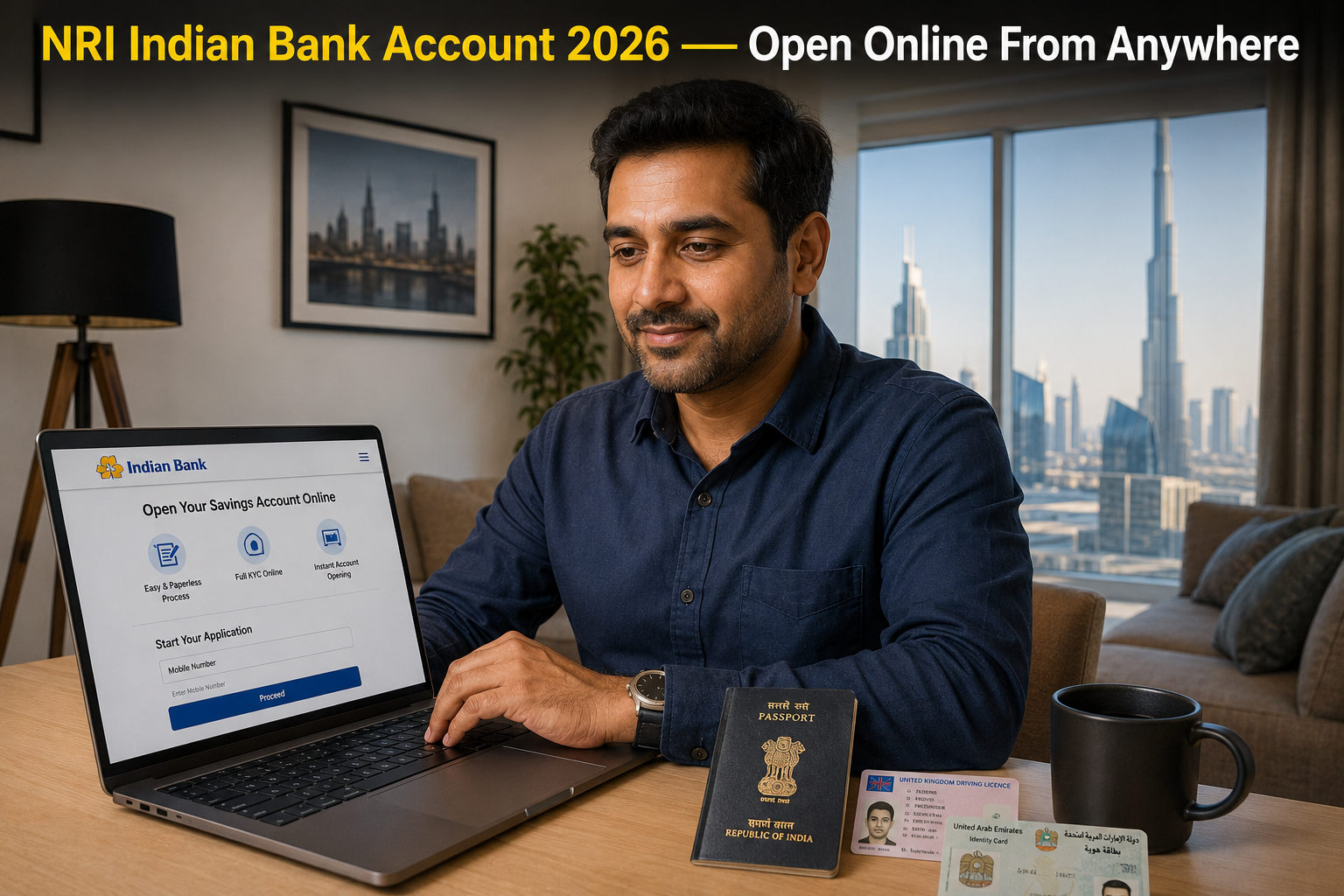
Which Banks Offer the Best NRI Account Opening Online
Several major Indian banks offer fully digital NRI account opening — no branch visit required anywhere in the world:
| Bank | Online Opening | Doorstep KYC Available | Video KYC |
|---|---|---|---|
| SBI (State Bank of India) | ✅ Yes | ✅ Yes (select countries) | ✅ Yes |
| HDFC Bank | ✅ Yes | ✅ Yes | ✅ Yes |
| ICICI Bank | ✅ Yes | ✅ Yes | ✅ Yes |
| Axis Bank | ✅ Yes | ✅ Yes | ✅ Yes |
| Kotak Mahindra Bank | ✅ Yes | ❌ Limited | ✅ Yes |
| Bank of Baroda | ✅ Yes | ✅ Yes | ❌ Limited |
PRO TIP: ICICI Bank and HDFC Bank currently offer the smoothest fully-digital NRI account opening experience — with Video KYC completing the process without any physical document submission. SBI has the widest physical presence abroad for those who prefer in-person verification.
Documents Required to Open NRI Account Online
Gather these before starting any application. All banks require essentially the same set:
Mandatory for all NRIs:
- Valid Indian Passport — biographical pages (first and last page)
- Valid Visa or Residence Permit of country of residence — showing your NRI status
- Overseas address proof — utility bill, bank statement, or tenancy agreement (not older than 3 months)
- Indian address proof — Aadhaar card, voter ID, or any government-issued document with Indian address
- PAN Card — mandatory for tax compliance. Apply at onlineservices.nsdl.com if you do not have one
- Recent passport-size photograph — white background
- Signature on white paper — scanned clearly
Additional for specific countries:
| Country | Extra Document |
|---|---|
| UAE | Emirates ID (front and back) |
| UK | UK Driving Licence or Biometric Residence Permit |
| USA | US Social Security Number declaration or W-8BEN form |
| Canada | Canadian PR Card or Work Permit |
| Australia | Australian PR or Visa Grant Notice |
IMPORTANT: All documents must be self-attested — sign across the photocopy with the date. Some banks require documents attested by the Indian Embassy or a Notary Public in your country of residence. Check your specific bank’s requirements before submitting.
Step-by-Step Process — Opening NRI Account Online
The process is broadly similar across all major banks. This walkthrough uses the general digital process:
Step 1 — Start Your Application Online
Go to your chosen bank’s NRI section:
- SBI: sbi.co.in/nri
- HDFC: hdfcbank.com/nri
- ICICI: icicibank.com/nri
- Axis: axisbank.com/nri
Click “Open NRI Account” and select the account type — NRE Savings, NRO Savings, or FCNR Deposit.
Step 2 — Fill the Online Application Form
The form collects:
- Personal details — name exactly as in passport, date of birth, nationality
- Contact details — overseas mobile number and email address
- Current country of residence and residential address abroad
- Indian address
- Occupation details — employed, self-employed, business owner
- Annual income range
- Source of funds declaration — salary, business income, investments
Take 20–25 minutes to fill this carefully. Incorrect information causes rejection at the KYC stage.
Step 3 — Complete Video KYC
Most banks now offer Video KYC — a live video call with a bank representative who verifies your identity in real time. This replaces the need to physically submit documents or visit a branch.
For Video KYC:
- Keep your original passport ready to show on camera
- Be in a well-lit space with a plain background
- Have your overseas address proof ready to show
- The call typically takes 10 to 15 minutes
- Schedule it at a time convenient for India Standard Time — most banks conduct Video KYC during Indian banking hours (10 AM to 5 PM IST)
Step 4 — Submit Documents
After Video KYC, upload scanned copies of all required documents through the bank’s secure portal or email them to the NRI banking team. Some banks accept WhatsApp submission for initial review — check with your specific bank.
For banks that require physical document submission, use a tracked international courier. Deliver to the bank’s NRI processing centre address — not a local branch.
Step 5 — Fund Your Account
Most NRE and NRO accounts require a minimum initial deposit to activate:
| Bank | NRE Minimum Balance | NRO Minimum Balance |
|---|---|---|
| SBI | ₹1,00,000 (Metro) | ₹1,00,000 (Metro) |
| HDFC | ₹10,000 | ₹10,000 |
| ICICI | ₹10,000 | ₹10,000 |
| Axis | ₹10,000 | ₹10,000 |
Transfer the opening amount via international wire transfer to the bank’s designated account. The bank sends wire transfer instructions with account details after your KYC is approved.
Converting Your Existing Resident Savings Account to NRO
If you already have a resident savings account in India that you opened before leaving — you must convert it to NRO, not close it. Closing and reopening loses your account history and existing standing instructions.
The conversion process:
- Contact your Indian bank’s NRI services team — by email or their NRI helpline
- Submit a written request for conversion from Resident Savings to NRO
- Provide your current NRI status documents — passport, visa, overseas address proof
- The bank converts the account within 7 to 14 working days
- Your account number remains the same — only the account type changes
IMPORTANT: Do this within a reasonable time of becoming an NRI. The Foreign Exchange Management Act (FEMA) requires NRIs to redesignate their accounts. While penalties for delay are rarely enforced for honest cases, being compliant protects you during any future tax inquiry or repatriation request.
Tax Rules NRIs Must Know Before Opening Accounts
NRE Account
- Interest earned is completely tax-free in India
- No TDS deducted
- You may still need to declare this income in your country of residence depending on local tax laws — consult a tax advisor in your country
NRO Account
- Interest is taxable in India at 30% plus applicable surcharge and cess
- TDS is deducted automatically by the bank before crediting interest
- India has Double Taxation Avoidance Agreements (DTAA) with over 90 countries — if your country has a DTAA with India, you may pay a lower TDS rate by submitting Form 15G/15H or a Tax Residency Certificate
FCNR Account
- Interest is tax-free in India
- No TDS
- Currency risk is eliminated since the deposit stays in foreign currency
Repatriating Money From India — What NRIs Can and Cannot Do
| Account Type | Repatriation Limit | Process |
|---|---|---|
| NRE | Unlimited — principal and interest both freely repatriable | Direct transfer to overseas account |
| NRO | Up to USD 1 million per financial year after paying applicable taxes | Submit Form 15CA and 15CB with bank |
| FCNR | Unlimited — principal and interest both freely repatriable | Direct transfer to overseas account |
For NRO repatriation above USD 250,000, a Chartered Accountant’s certificate in Form 15CB is mandatory before the bank processes the transfer.
State-Wise NRI Banking Support Centres in India
When you visit India, these cities have dedicated NRI banking branches at most major banks for in-person support:
- Mumbai — Largest NRI banking hub. SBI, HDFC, ICICI all have dedicated NRI branches at Nariman Point and Bandra Kurla Complex
- Chennai — Strong NRI banking presence, particularly for Gulf-based NRIs
- Kochi — Highest density of NRI accounts in India proportionally — excellent branch support
- Hyderabad — Growing NRI banking centre for USA-based Indian community
- Ahmedabad — Strong for UK-based Gujarati NRI community
Frequently Asked Questions
Q: I left India 10 years ago and still have my old savings account. Is this a problem?
Technically yes — FEMA requires conversion to NRO once you become a non-resident. However, banks rarely take action unprompted. Convert it now by contacting your bank’s NRI team — the process is simple and protects you from any future compliance issue during repatriation or tax filing.
Q: Can I open an NRI account without a PAN card?
You can start the application but cannot complete it without PAN. PAN is mandatory under Indian tax law for NRIs with Indian bank accounts. Apply online at onlineservices.nsdl.com — NRIs can apply for PAN from abroad using passport as identity proof.
Q: Can two NRI siblings jointly open an NRE account?
Yes. NRE accounts can be held jointly with another NRI. The joint holder must also complete KYC separately. NRE accounts cannot be jointly held with a resident Indian — use NRO for joint holding with a family member living in India.
Q: I am an OCI cardholder, not an Indian citizen. Can I open an NRI account?
OCI cardholders are treated as NRIs for banking purposes under FEMA. You can open NRE and NRO accounts using your OCI card, foreign passport, and overseas address proof. The process is identical to Indian passport holders.
Q: How long does it take to open an NRI account completely online?
With Video KYC, most banks complete the process within 5 to 7 working days from application submission to account activation. FCNR deposits may take slightly longer as they involve treasury operations.
Q: My salary is credited in UAE dirhams. Can I directly deposit dirhams into my NRE account?
No. NRE accounts are in Indian Rupees. Your bank converts the foreign currency remittance to INR at the prevailing exchange rate when crediting. For holding money in AED without conversion, open an FCNR account in AED — several Indian banks offer AED-denominated FCNR deposits specifically for Gulf-based NRIs.
The Practical First Step for Every NRI Reading This
Check your Indian bank account status today. Log in to your bank’s net banking — if it shows a regular savings account rather than NRE or NRO, call your bank’s NRI helpline this week and initiate conversion.
If you do not have any Indian account at all and want to start sending money home or investing in India, open an NRE account first. It gives you the most flexibility — tax-free interest and complete freedom to move money back to your overseas account whenever needed.
Share this with NRI friends and family who are still operating resident savings accounts without realising the compliance requirement. A simple account conversion protects them from complications they would rather not face during a tax filing or property transaction.
About the Author C. Thiruvenkatam is the founder and editor of Daily Hind News. With over a decade of experience in digital publishing and Indian civic information, he helps English-speaking Indians worldwide navigate government processes, schemes, and citizen services with clarity and confidence.