India e-Visa 2026: Complete Guide for Foreign Nationals — Types, Fees, How to Apply & What Happens at the Airport
By C. Thiruvenkatam | Daily Hind News | 3 June 2026
Planning a trip to India does not start at the airport. It starts with understanding which visa you need, how to apply correctly, and what to carry when you land. Getting this wrong — a mismatched purpose of visit, a missed document, or an expired Electronic Travel Authorization — can mean being turned away at the immigration counter after a 10-hour flight.
This guide covers the India e-Visa system in 2026 completely and honestly — from which countries are eligible, to what the application form actually asks, to what happens the moment you hand your passport to the immigration officer at an Indian airport. Every piece of information here comes from official Government of India sources.
What the India e-Visa Is — And What It Is Not
The India e-Visa is an Electronic Travel Authorization (ETA) — a digital permission granted by the Government of India that allows eligible foreign nationals to enter India without visiting an Indian Embassy or Consulate in person.
Once approved, your ETA is linked electronically to your passport. You receive it by email. You print it and carry it with your passport. The immigration officer at the Indian airport scans your passport, sees the ETA in the system, stamps your visa, and you enter India.
What the e-Visa is not:
- It is not a sticker in your passport — there is no physical stamp until you arrive
- It is not issued by embassies — it is issued entirely online by the Government of India
- It is not the same as a regular Indian visa — it has specific conditions and restrictions
- It cannot be extended inside India — you must exit and reapply if you need more time
The official portal lists nine e-Visa sub-types: e-Tourist, e-Business, e-Medical, e-Medical Attendant, e-Student, e-Family, e-Transit, e-Miscellaneous, and e-Production Investment.
Which Countries Are Eligible
India expanded the e-Tourist Visa to include nationals from 166 additional countries, with the Ministry of Tourism updating the official guidance in early 2026. Citizens of over 160 countries are now eligible for at least one category of India e-Visa.
Notable countries where citizens are eligible include USA, UK, Australia, Canada, Germany, France, Japan, Singapore, UAE, Saudi Arabia, South Africa, and most of Europe, Asia-Pacific, and the Americas.
Countries not eligible for e-Visa include Pakistan, Afghanistan, and a small number of other nations — citizens of these countries must apply through the traditional visa route at an Indian Embassy.
IMPORTANT: Always verify your specific country’s eligibility on the official portal at indianvisaonline.gov.in before applying. Eligibility occasionally changes based on bilateral diplomatic decisions.
The 9 Types of India e-Visa — Which One You Need
Choosing the correct visa type is the most critical step. Using the wrong category — for example, doing business activities on a Tourist visa — is a visa violation that can result in deportation and a future entry ban.
1. e-Tourist Visa
For: Sightseeing, recreation, visiting friends and relatives, attending short-term yoga programmes, casual visits.
| Duration | Entries Allowed | Max Stay Per Visit |
|---|---|---|
| 30 days | Double entry | 30 days total |
| 1 year | Multiple entry | 90 days per visit |
| 5 years | Multiple entry | 90 days per visit |
For e-Tourist Visa (30 days), the validity is 30 days from the date of your first arrival in India with double entries permitted within the validity period.
You cannot work, conduct business meetings, or receive medical treatment on a Tourist visa.
2. e-Business Visa
For: Business meetings, trade discussions, attending conferences, signing contracts, exploring investment opportunities.
The e-Business visa is valid for 365 days from the date the authorization is granted, allows multiple entries, with a maximum continuous stay of 180 days per visit.
If you plan to stay more than 180 days continuously, you must register with the local Foreigners Regional Registration Office (FRRO) within two weeks after crossing the 180-day mark.
Required document beyond standard: Business card or invitation letter from the Indian company you are visiting — including company name, address, and phone number.
3. e-Medical Visa
For: Medical treatment at a recognised Indian hospital or medical institution.
The e-Medical visa is valid for 60 days from the date of arrival and allows triple entry.
Required beyond standard documents: Letter from the treating Indian hospital confirming the treatment, including dates and nature of medical care.
India’s medical tourism industry — particularly for cardiac surgery, orthopaedics, cancer treatment, and Ayurveda — attracts patients from Africa, the Middle East, and Southeast Asia significantly. The e-Medical visa was created specifically for this.
4. e-Medical Attendant Visa
For: Family members or companions accompanying an e-Medical Visa holder.
Only two e-Medical Attendant Visas will be granted against one e-Medical Visa.
The Attendant visa validity matches the patient’s e-Medical visa period. The attendant cannot engage in any other activity — tourism, business, or employment — during the stay.
5. e-Student Visa
For: Students enrolled in recognised Indian educational institutions for courses exceeding 6 months.
For shorter courses and workshops, the e-Tourist visa is typically sufficient — check with your institution before applying for Student category.
6. e-Transit Visa
For: Foreign nationals transiting through India to a third country, with a layover exceeding 24 hours requiring exit from the transit area.
Transit stays under 24 hours where you remain airside do not typically require a visa — verify with your airline.
7. e-Conference Visa
For: Attending conferences, seminars, and workshops organised by government bodies or reputed organisations in India.
Foreigners applying for e-Conference visa will be permitted to club the activities permitted under e-Tourist visa only, with validity co-terminus with the e-Conference Visa — 30 days.
8. e-Miscellaneous Visa
For: Activities not covered under other categories — journalism, film production (short term), research visits.
9. e-Production Investment Visa
For: Foreign nationals investing in Indian film and media production.
e-Visa Fees 2026 — What You Actually Pay
Fees vary by nationality and visa category. There is no single universal fee.
For the e-Tourist visa, the 30-day option costs $10 during India’s off-peak season (April through June) and $25 from July through March for most nationalities. The one-year e-Tourist visa runs $40 for many countries, while the five-year version ranges from $25 for Japan to $484 for UK and several European nations depending on your passport.
| e-Visa Type | Typical Fee Range |
|---|---|
| e-Tourist 30 days (off-peak Apr–Jun) | USD 10 |
| e-Tourist 30 days (peak Jul–Mar) | USD 25 |
| e-Tourist 1 year | USD 40 |
| e-Tourist 5 years | USD 25 – USD 484 (varies by nationality) |
| e-Business | USD 80 (most nationalities) |
| e-Medical | USD 25 – USD 80 |
Bank transaction charges of 3% will be charged additionally on applicable e-Visa fees. The fee must be paid at least 4 days before the expected date of travel. e-Visa fee once submitted is non-refundable as the fee is for processing of the application and is not dependent on either grant or rejection of the Electronic Travel Authorization.
Critical point: The fee is non-refundable regardless of approval outcome. Ensure all your documents are correct before paying.
To find your country’s exact fee: Go to indianvisaonline.gov.in → Click “Visa Fees” → Select your nationality.
How to Apply — Step by Step
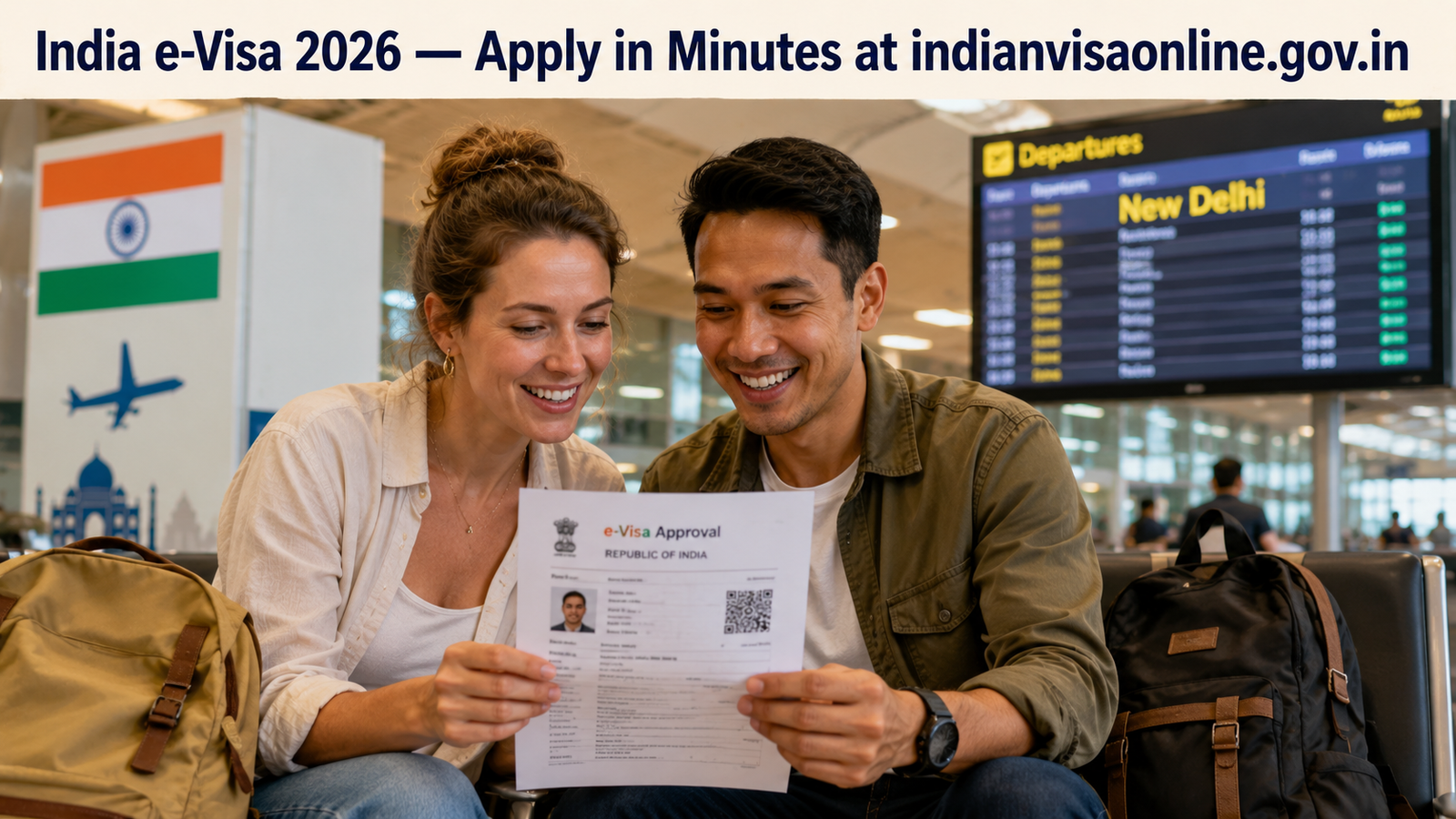
The only official portal is indianvisaonline.gov.in/evisa/tvoa.html
Applicants are advised to be cautious and only use the Government of India portal. Be careful of fraudulent websites offering e-visa services for India.
Dozens of third-party websites charge $50 to $150 to “assist” with the application that you can complete yourself in 15 minutes on the official portal for the government fee alone.
Step 1 — Start Your Application
- Go to indianvisaonline.gov.in
- Click “Apply e-Visa”
- Select your nationality and visa category
- Select your expected arrival date in India
- The system calculates your eligible visa options
For e-Tourist and e-Business visa, applicants may apply online minimum 4 days in advance of the date of arrival. Applications can be made up to 120 days in advance.
Do not apply on the day of travel — 4 days is the absolute minimum and does not account for any processing delays.
Step 2 — Fill the Application Form
The form has multiple sections covering:
- Personal details — name exactly as in passport, date of birth, nationality, religion
- Passport details — passport number, date of issue, date of expiry, place of issue
- Contact details — email address, phone number, current address
- Travel details — port of entry, expected arrival date, address in India
- Family background — parents’ nationality, whether previously visited India
- Employment details — occupation, employer name and address
The portal lets you save progress using a temporary Application ID if you need to step away and gather additional documents. Accuracy matters enormously: any mismatch between the form and your passport is grounds for denial at the border.
Take your time. Do not rush the form. Every field must match your passport exactly — including spelling of your name, passport number, and dates.
Step 3 — Upload Documents
Two documents are mandatory for all e-Visa types:
1. Passport photo page scan:
- Clear scan of the biographical page of your passport
- Must show your photo, name, passport number, dates clearly
- File format: PDF
- Maximum file size: 300 KB
2. Your photograph:
- Recent, front-facing, colour photograph
- White background — no exceptions
- Dimensions: 2 inch × 2 inch
- File format: JPEG
- Maximum file size: 1 MB
- No sunglasses, head coverings (except for religious reasons), or heavy shadows
Additional documents by visa type:
- e-Business: Business card or invitation letter from Indian company
- e-Medical: Hospital letter confirming treatment
- e-Conference: Invitation from organising body in India
IMPORTANT: Photograph rejection is the most common reason for e-Visa application failure. The system auto-checks photograph dimensions and background. Use a plain white wall, good lighting from the front, and no shadows on the face or background. Take the photo specifically for this application — do not use a cropped passport photo from years ago.
Step 4 — Pay the Fee
After completing the form, you are directed to the payment page. Pay using:
- International credit card (Visa, Mastercard, American Express)
- Debit card with international payment enabled
- Net banking (select Indian banks only)
Bank transaction charges of 3% will be charged additionally on applicable e-Visa fees.
Save the payment receipt immediately after payment. You will need your Application ID (generated after payment) to track your application status.
Step 5 — Wait for Your ETA
After completing the whole online application, it normally takes 3 working days for processing.
During peak tourist seasons (October through January) and around Indian public holidays, processing may extend to 4 to 5 working days.
You receive your approved ETA by email. The email contains a PDF attachment — your Electronic Travel Authorization. Check that it shows “GRANTED” status.
Also verify on the portal: Go to indianvisaonline.gov.in → “Check Your Visa Status” → Enter Application ID and passport number.
Step 6 — Print Your ETA Before Travelling
Print a physical copy of your ETA. Some airlines ask to see it before allowing boarding. Immigration officers at Indian airports will want to see it alongside your passport.
Do not assume the immigration officer will find it entirely in the system without your printed copy — always carry the printout.
Designated Entry Points for e-Visa Holders
e-Visa holders cannot enter India through every port. Entry is only permitted through designated airports and seaports.
Designated airports (major ones):
| City | Airport |
|---|---|
| New Delhi | Indira Gandhi International Airport |
| Mumbai | Chhatrapati Shivaji Maharaj International Airport |
| Bengaluru | Kempegowda International Airport |
| Chennai | Chennai International Airport |
| Hyderabad | Rajiv Gandhi International Airport |
| Kolkata | Netaji Subhas Chandra Bose International Airport |
| Kochi | Cochin International Airport |
| Ahmedabad | Sardar Vallabhbhai Patel International Airport |
| Goa | Goa International Airport (Dabolim) |
| Jaipur | Jaipur International Airport |
India also expanded e-Visa entry to 14 seaports in 2026, covering major cruise terminals. Check the complete current list at indianvisaonline.gov.in.
IMPORTANT: If you plan to enter India overland — through Nepal, Bhutan, or Bangladesh border crossings — the e-Visa does not permit land entry in most cases. Apply for a regular visa at an Indian Embassy if you plan an overland entry.
At the Indian Airport — What Happens Step by Step
Many first-time visitors to India are unsure what to expect at immigration. Here is the actual sequence:
- Disembark and follow signs to Immigration — separate queues for Indian citizens and foreign nationals
- Join the foreign nationals queue
- At the counter, present:
- Your valid passport (minimum 6 months validity from date of arrival)
- Your printed ETA
- Completed Arrival Card (distributed on the aircraft or available at the airport)
- Biometrics captured — fingerprints and photograph taken at the counter for first-time e-Visa visitors
- Immigration officer stamps your passport — the e-Visa stamp appears on a blank page
- Proceed to Baggage Claim
The immigration process typically takes 20 to 45 minutes at major airports during peak hours.
What to have ready in your bag (not checked luggage):
- Passport
- Printed ETA
- Return flight ticket or onward travel proof
- Hotel booking confirmation for first night
- Sufficient funds proof if asked (credit card, bank statement)
Common Reasons e-Visa Applications Are Rejected
Understanding rejections helps you avoid them:
| Rejection Reason | How to Avoid It |
|---|---|
| Name mismatch — form vs passport | Copy name exactly as printed in passport |
| Passport expiring within 6 months of arrival | Renew passport before applying |
| Photograph does not meet specifications | Use fresh white-background photo |
| Wrong visa category selected | Read category descriptions carefully |
| Applying from a non-eligible country | Check eligibility before starting |
| Incomplete form submission | Complete all mandatory fields |
| Payment failure not resolved | Verify payment confirmation before closing browser |
If your application is rejected, the fee is non-refundable. You can reapply — there is no mandatory waiting period after rejection.
Frequently Asked Questions
Q: Can I extend my India e-Visa after arriving in India?
The e-Tourist and e-Business visas cannot be extended inside India. If you need more time, exit the country and reapply. In exceptional circumstances — medical emergency, natural disaster — contact the local FRRO office with supporting documentation.
Q: I applied 6 days ago and still have not received my ETA. What do I do?
Check your spam folder first. Then verify the status at indianvisaonline.gov.in using your Application ID. If status shows pending beyond 5 working days, email the official helpline at indiatvoa@gov.in with your Application ID and passport number.
Q: Can my family apply together on one form?
There is no group or family submission option. Each traveler files separately, even children. Every family member needs a separate application, separate fee payment, and separate ETA.
Q: My e-Visa was granted but my travel plans changed. Can I get a refund?
No. The fee is non-refundable under all circumstances — including if you never travel. Plan your application only when travel is confirmed.
Q: I am an Indian-origin person with a foreign passport. Do I need an e-Visa?
If you hold an OCI card, you do not need a visa to enter India. If you are a Person of Indian Origin (PIO) without an OCI card, you need a visa like any other foreign national. Consider converting your PIO card to OCI — it is a permanent solution for multiple India visits.
Q: Can I travel to Pakistan from India on an e-Visa and re-enter India?
India does not currently offer e-Visa to Pakistani nationals and travel between India and Pakistan has specific restrictions. This does not apply to other nationalities — most countries can freely enter and exit India multiple times within the e-Visa validity.
One Thing That Surprises Most First-Time Visitors
India processes millions of e-Visa applications annually — the system is well-tested and efficient for straightforward cases. The problems almost always happen when applicants rush the form, upload low-quality photographs, or choose the wrong visa category.
Apply at least 7 to 10 days before your travel date — not the minimum 4 days. This buffer absorbs any processing delay without disrupting your plans.
And use only indianvisaonline.gov.in — ignore every other website that appears in search results offering to “process your India e-Visa” for a fee. They charge significantly more for something you complete yourself in 15 minutes on the official portal.
India is genuinely worth the planning. The e-Visa system exists to make the first step as simple as possible.
How NRIs Can Open an Indian Bank Account Online in 2026: NRE, NRO and FCNR Accounts Explained Simply
About the Author C. Thiruvenkatam is the founder and editor of Daily Hind News. With over a decade of experience in digital publishing and Indian civic information, he helps English-speaking Indians worldwide navigate government processes, schemes, and citizen services with clarity and confidence.