PM Vishwakarma Yojana 2026: ₹3 Lakh Loan at 5%, Free Toolkit & Where to Actually Register
By C. Thiruvenkatam | Daily Hind News | 8 June 2026
India has over 3 crore traditional craftsmen — carpenters, blacksmiths, potters, cobblers, tailors, barbers, and eighteen trades in between. Most of them work every single day with tools that are worn, inadequate, and decades old. Most of them borrow from local moneylenders when they need working capital, at rates that quietly consume whatever margin they earn. And most of them have heard of PM Vishwakarma Yojana — the government scheme launched specifically to change their situation — but either believe they are not eligible, or have tried to find the application link online, failed, and given up.
That gap between a ₹13,000 crore scheme and the artisans it was built for is a problem that should not exist.
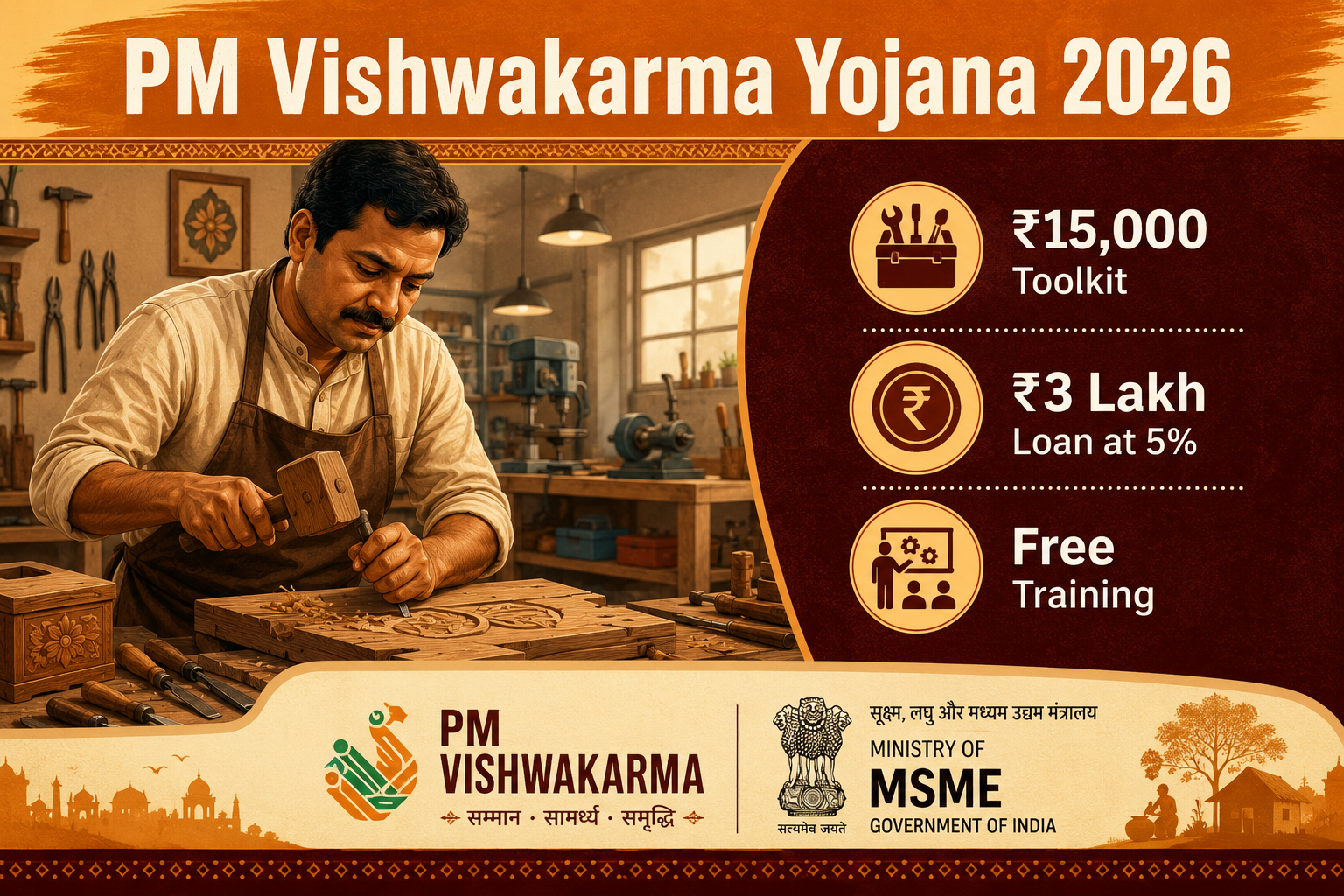
If you work with your hands in one of the 18 listed trades and you are reading this, the scheme is almost certainly available to you. The ₹15,000 toolkit benefit, the training stipend, and the ₹3 lakh collateral-free loan at 5% interest — all of it is accessible. But you cannot register online. That is the one thing most articles on this subject get wrong, and it is the thing that has sent lakhs of artisans away empty-handed after visiting pmvishwakarma.gov.in and finding no application form.
Registration happens in person, at a CSC centre, using your Aadhaar biometric. Everything else follows from that visit.
First: Are You Eligible?
No income cap. That is the first thing to know. PM Vishwakarma does not exclude artisans based on how much they earn. The eligibility conditions are about your trade, your employment status, and your recent loan history — not your income.
You qualify if:
- You are an Indian resident, aged 18 or above
- You practise one of the 18 listed traditional trades (see full list below)
- You work with your hands — alone or as a family-based unit
- You are not a government employee
- You have not taken a PMEGP, MUDRA, or PM SVANidhi loan in the last 5 years
That last condition is the one almost no article mentions clearly. If you took a MUDRA loan in 2023 or a PMEGP loan in 2022, you are currently ineligible — not permanently, but until 5 years have passed from the date of that loan. Check your bank records before making a trip to the CSC, so you know where you stand.
One more household rule: only one family member can register. Family here means husband, wife, and unmarried children living together. If both you and your spouse work as tailors, only one of you can register under PM Vishwakarma. Decide before you go.
All 18 Eligible Trades
Many artisans do not register because they are unsure whether their specific trade qualifies. Here is the complete list:
| # | Official Trade Name | Common Indian Name |
|---|---|---|
| 1 | Carpenter | Suthar / Badhai |
| 2 | Boat Maker | Naav Nirmaata |
| 3 | Armourer | Aastra Nirmaata |
| 4 | Blacksmith | Lohar |
| 5 | Hammer and Tool Kit Maker | Haथौड़ा/औzaar Nirmaata |
| 6 | Locksmith | Taala Nirmaata |
| 7 | Goldsmith | Sonar |
| 8 | Potter | Kumhar |
| 9 | Sculptor | Moortikar / Pathar Todi |
| 10 | Cobbler / Shoemaker | Mochi |
| 11 | Mason | Raj Mistri |
| 12 | Basket / Mat / Broom Maker | Tokri/Chatai/Jhadu Nirmaata |
| 13 | Doll and Toy Maker | Khilona Nirmaata |
| 14 | Barber | Naai |
| 15 | Garland Maker | Malakaar |
| 16 | Washerman | Dhobi |
| 17 | Tailor | Darzi |
| 18 | Fishing Net Maker | Jaal Nirmaata |
If your trade appears on this list and you meet the other conditions, you are eligible. Age does not disqualify you if you are 18 or older. The scheme does not require any minimum years of experience in the trade.
What the Scheme Actually Gives You
PM Vishwakarma is not a single benefit — it is a five-stage package. Understanding the sequence matters because each stage unlocks the next.
Stage 1 — Recognition: After registration at the CSC, you receive an official PM Vishwakarma Certificate and a government-issued ID card. This is not a formality — it establishes your identity as a recognised artisan under the Ministry of MSME, which opens doors to the credit and procurement opportunities that follow.
Stage 2 — Training and Stipend: Within 2 to 3 weeks of registration, you will be called for Basic Training — 5 to 7 days — at a training centre in your district. During training, ₹500 per day is credited directly to your bank account via DBT (Direct Benefit Transfer). An optional Advanced Training of 15 days is available for those who want it, with the same daily stipend.
Stage 3 — Toolkit Incentive: After completing the skill assessment that follows training, you receive a toolkit incentive of ₹15,000. This does not arrive as cash in your bank account. It comes as an e-voucher, credited to your registered account, which you use to purchase specific modern tools related to your trade from government-empanelled vendors. You cannot spend it on anything else. You cannot withdraw it as cash. It is designed to put better tools in your hands — not money in your pocket. Understand this before you expect a bank transfer.
Stage 4 — Credit at 5% Interest: After the toolkit stage, your loan application is forwarded to an empanelled bank. The loan comes in two tranches:
- First tranche: ₹1 lakh — collateral-free, at 5% per annum, repayable over 18 months
- Second tranche: ₹2 lakh — available only after successfully repaying the first loan, at 5% per annum, repayable over 30 months
You cannot receive ₹3 lakh upfront. Any article or agent claiming you can get ₹3 lakh in one shot is wrong. The government’s logic is sound — a demonstrated repayment record earns you the larger tranche. Think of it as a credit ladder, not a lump sum.
Stage 5 — Digital Transaction Incentive: Once registered, if you start accepting digital payments from customers — via UPI or any other digital mode — you earn ₹1 per transaction credited to your account, up to a capped monthly limit. This is an incentive to bring artisans into the formal digital economy. [Please confirm current monthly transaction cap at pmvishwakarma.gov.in]
The Registration Process — Exactly What Happens at the CSC
The Common Service Centre is your only registration point. Find your nearest one at locator.csccloud.in — enter your district and it lists nearby centres with addresses and contact numbers.
What to carry:
- Aadhaar card (original)
- Mobile number linked to Aadhaar (for OTP)
- Bank account details (passbook or cancelled cheque)
- Ration card or any document showing your trade — not mandatory, but useful if the CSC operator asks
At the centre:
The CSC operator opens pmvishwakarma.gov.in on their system. They enter your Aadhaar number and authenticate it using the biometric device at the centre — your fingerprint. This is why self-registration at home is not possible; the biometric device is at the CSC, not on your phone.
After biometric authentication, the operator fills in your personal details, trade category, bank account number, and district. You verify the details on the screen. The operator submits the registration. You receive an acknowledgement slip with your application reference number.
Your PM Vishwakarma Certificate and digital ID card are then issued — usually within a few days of registration approval by the local implementing authority.
The entire process at the CSC takes roughly 20 to 30 minutes if your documents are in order.
The registration is completely free. CSC operators are paid by the government for processing registrations. If any operator, agent, or middleman asks you for money — even ₹50 or ₹100 — refuse. Walk out. Report the centre on the PM Vishwakarma helpline: 18002677777. Paid agents running registration scams have been reported in several districts. The scheme requires zero payment from you at any stage.
Benefits Timeline — From Registration to Loan
Here is the sequence in approximate time, so you know what to expect and when:
| Stage | Timeframe After Registration | What You Get |
|---|---|---|
| CSC Registration | Day 1 | PM Vishwakarma Certificate + ID Card |
| Basic Training | Week 2–4 | 5–7 days training + ₹500/day via DBT |
| Skill Assessment | After training | Qualification for toolkit |
| Toolkit E-Voucher | After assessment | ₹15,000 e-voucher for tool purchase |
| Loan Application | After toolkit stage | File forwarded to empanelled bank |
| First Loan Disbursement | Post-bank processing | ₹1 lakh at 5% — 18-month repayment |
| Second Loan | After full 1st repayment | ₹2 lakh at 5% — 30-month repayment |
Timelines between stages depend on your district’s implementing authority, training centre availability, and bank processing. In busy districts, the gap between registration and training call can stretch to 4 to 6 weeks. Follow up with your CSC operator if you have not received a training call within a month of registration.
PM Vishwakarma vs PM MUDRA — Which Scheme Is for You?
Artisans often confuse these two. Both offer credit to small businesses. The differences are significant:
| Feature | PM Vishwakarma | PM MUDRA |
|---|---|---|
| Who It Is For | 18 specific traditional trades only | Any non-farm micro/small business |
| Interest Rate | 5% (government subsidised) | Market rate — typically 10–14% |
| Collateral | None required | None for Shishu/Kishore; conditions vary |
| Loan Amount | Up to ₹3 lakh (in 2 tranches) | Up to ₹10 lakh (Tarun category) |
| Training and Toolkit | Included — free | Not included |
| Previous MUDRA Loan | Disqualifies you for 5 years | No such restriction |
| Application Route | CSC biometric registration | Directly at any bank or NBFC |
| Target | Artisans in listed trades | Wider small business owners |
If you are in one of the 18 listed trades and have not taken a MUDRA loan in the last 5 years, PM Vishwakarma is financially better — the 5% rate versus market rate is a meaningful difference over an 18-month or 30-month repayment period. If you are not in a listed trade or have a recent MUDRA loan on record, MUDRA is your available route.
West Bengal Artisans — The Scheme Is Now Open for You
For the first time since PM Vishwakarma launched in September 2023, artisans in West Bengal can now register through the regular CSC process.
West Bengal did not participate in the scheme from the start due to state government approval delays. As of May 2026, the state government has formally enrolled. Approximately 7.79 lakh WB artisans had already pre-registered through an interim process and are expected to be brought into the active scheme rolls in this phase.
If you are a craftsman in West Bengal who tried to register earlier and was told the scheme was not available in your state — try again at your nearest CSC now. The situation has changed.
Where the Scheme Stands in June 2026
The numbers from the Ministry of MSME tell a story that matters for one specific reason: they prove the benefits are actually reaching people, not sitting in a government announcement.
As of May 2026: over 30 lakh artisans registered across India — a target the scheme had set for 2027–28, achieved roughly three years early. Over 24 lakh completed Basic Training. More than 16 lakh received the ₹15,000 toolkit benefit. Over 5.94 lakh loan sanctions approved. ₹5,092 crore in loans disbursed.
The pipeline is moving. If your registration is processed and your training is completed, the toolkit and loan are not hypothetical — they are being disbursed at scale.
Frequently Asked Questions
I tried pmvishwakarma.gov.in and could not find a registration form. Where is it? The portal does not have a self-registration form for artisans. It is used for status checking and back-end processing only. Registration happens exclusively at a CSC centre using Aadhaar biometric authentication. Find your nearest CSC at locator.csccloud.in.
My trade is not on the 18-trade list. Can I still apply? No — the scheme is restricted to the 18 listed trades as of the current notification. Check the list again carefully, including local names. If your trade is genuinely not listed, PM MUDRA or a regular bank business loan would be your available routes.
I registered 6 months ago but have not received a training call. What should I do? Call the PM Vishwakarma helpline at 18002677777. Provide your registration reference number. Delays in training call-up are common in states with high registration volumes — a follow-up call usually moves the process.
Can a woman artisan — a tailor, weaver, or basket-maker — register? Yes, fully. The scheme has no gender restriction. Women artisans in all 18 listed trades qualify on the same terms as male artisans. The one-per-family rule applies equally — if the husband is already registered in the same household, the wife cannot register for the same family unit.
My son and I both work as carpenters. Can we both register? If you live together as one family unit — husband, wife, unmarried children — only one registration is permitted per household. If your son is married and lives as a separate household, he can register independently under his own family unit.
Is the 5% interest rate fixed for the full loan period or can it change? The scheme currently specifies 5% per annum as the concessional rate, with the difference between 5% and the bank’s regular rate being covered by a government interest subvention. [Please confirm whether rate is fixed for the full tenure or subject to quarterly revision under scheme guidelines at msme.gov.in]
If you are a carpenter who still uses your father’s chisel, a tailor whose sewing machine needs replacing, or a potter whose kiln runs on borrowed credit — this scheme was specifically designed for the situation you are in right now. The registration is free, the CSC is likely within reach, and the queue is shorter in June 2026 than it will be after the next publicity push.
Find your nearest CSC at locator.csccloud.in. Carry your Aadhaar. Go this week.
Scheme details, timelines, and benefit amounts are drawn from the Ministry of MSME’s official portal at pmvishwakarma.gov.in. Verify current status of your specific state and district implementation before visiting a CSC.
Ayushman Bharat Card 2026: How to Apply Online, Check Eligibility & Get Free Treatment Up to ₹5 Lakh
About the Author
C. Thiruvenkatam is the founder and editor of Daily Hind News (dailyhindnews.in), an English-language site covering Indian government schemes, civic documents, NRI services, and public welfare programmes for readers across India and abroad. He has tracked MSME and artisan welfare schemes from their notification stage through ground-level implementation, following scheme uptake data, state-level launch timelines, and CSC process updates across multiple programme cycles. For editorial queries: dailylifearticles@gmail.com.