Kisan Credit Card 2026: ₹5 Lakh at 4% Interest – Who Qualifies, How to Apply & Why Most Farmers Are Not Using It
By C. Thiruvenkatam | Daily Hind News | 3 June 2026
Every harvest season, millions of Indian farmers borrow money from local moneylenders at interest rates of 24%, 36%, sometimes higher. The same farmers are eligible for institutional credit at 4% per annum through the Kisan Credit Card scheme — and most of them either do not know it exists, or believe they are not eligible.
That gap between what is available and what is being used is the real problem this article addresses.
The Union Budget 2025-26 raised the Kisan Credit Card interest subvention ceiling from ₹3 lakh to ₹5 lakh, benefiting over 7.75 crore active KCC holders. If you are a farmer — owner, tenant, sharecropper, dairy farmer, or fisherman — and you do not yet have a KCC, here is everything you need to know to get one.
What the Kisan Credit Card Actually Is
The Kisan Credit Card is not a regular credit card. It works more like a pre-approved revolving credit line — linked to a savings account — that a farmer can draw from whenever needed and repay after harvest.
Think of it this way: instead of going to a moneylender in April for seed money and repaying at 30% interest after October harvest, a KCC holder walks to the nearest ATM, withdraws what they need, and repays after selling the crop — at 4% effective interest.
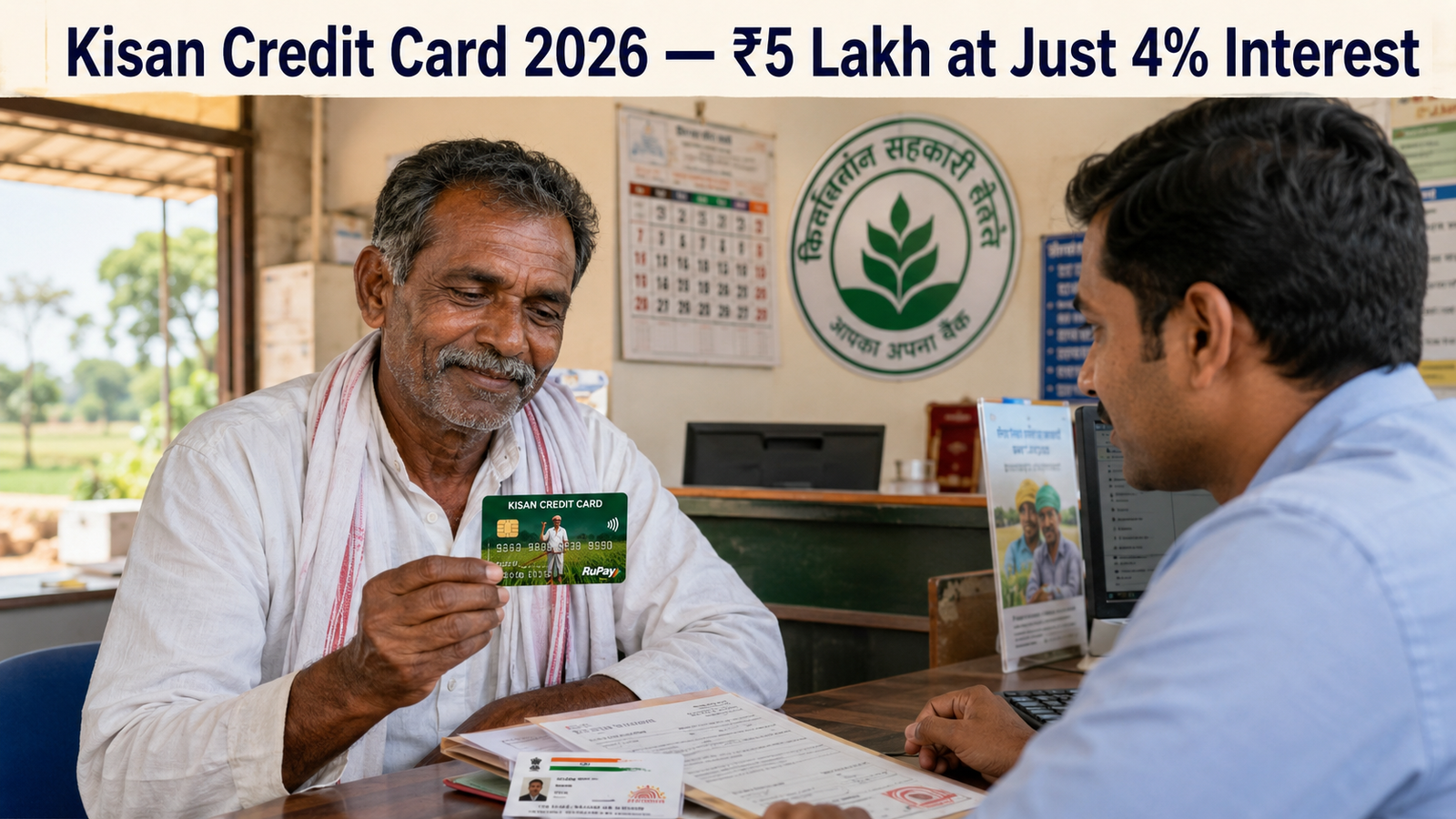
The card is a physical RuPay chip card — usable at ATMs, at agricultural input shops, and for online transfers. It is not limited to one withdrawal — it is a credit facility you can use repeatedly within your sanctioned limit throughout the year.
The 4% Interest Rate — How It Actually Works
This is where most people get confused. Banks do not lend at 4% — they lend at their standard agricultural rate, which varies between 7% and 9% depending on the bank.
The government then steps in with two layers of subsidy: https://www.myscheme.gov.in/schemes/kcc
| Component | Reduction |
|---|---|
| Base bank lending rate | 7% (standard agricultural rate) |
| Government interest subvention (MISS) | Minus 2% |
| Prompt repayment incentive | Minus 3% |
| Effective rate if repaid on time | 4% per annum |
The government offers a 2% interest subsidy and an additional 3% incentive for prompt repayment, bringing the effective interest rate down to just 4% per annum.
The 3% prompt repayment incentive is the critical one. It is credited back to your account only if you repay within the stipulated period — typically one year from the date of withdrawal. Repay on time and you pay 4%. Miss the deadline and you pay the full bank rate of 7% to 9%.
The practical takeaway: Borrow what you need. Repay within one year — ideally right after you sell your harvest. The 4% rate is not automatic — you earn it by repaying on time.
What KCC Covers — More Than Most Farmers Realise
Many farmers think KCC is only for buying seeds and fertilisers. The actual scope is considerably wider:
Crop cultivation expenses:
- Seeds, fertilisers, pesticides
- Labour costs for sowing, weeding, harvesting
- Irrigation expenses
Post-harvest expenses:
- Storage costs — renting a warehouse or cold storage
- Transportation to mandi
- Processing costs for agro-produce
Allied agriculture activities:
- Dairy farming — buying milch animals, feed costs
- Fishery — nets, boats, fish feed
- Poultry farming
- Sheep and goat rearing
Household and maintenance needs:
- Maintenance of farm equipment
- Household consumption needs of farmer families between harvest cycles
This breadth matters. A dairy farmer who does not grow crops can still get a KCC. A fisherman in coastal AP or Tamil Nadu qualifies. A family maintaining a small poultry unit in UP qualifies.
Who Is Eligible — The Complete Picture
Farmers Who Own Land
If you own agricultural land and cultivate it — individually or jointly with family — you are eligible. The bank calculates your credit limit based on the scale of finance for the crops you grow, multiplied by the area under cultivation.
Tenant Farmers and Sharecroppers
This is the group most underserved by the banking system — and the 2026 update specifically addresses them.
Tenant farmers, oral lessees, and sharecroppers can apply for Kisan Credit Card 2026 through self-declaration of cultivation, without needing formal land ownership documents like Khasra or Khatauni.
A sharecropper who has been farming someone else’s land for years can now apply using a self-declaration form — no landowner’s signature, no formal lease agreement required in most cases. This single change opens KCC access to crores of landless cultivators who were previously excluded.
Joint Liability Groups (JLGs)
Joint Liability Groups of 4 to 10 landless farmers are also fully eligible under the 2026 KCC framework.
If individual farmers in a village form a group, they can collectively apply for KCC — with joint liability for repayment. This is specifically designed for small and marginal farmers who do not individually meet bank requirements.
PM Kisan Beneficiaries — Priority Access
All PM Kisan Samman Nidhi beneficiaries are now auto-eligible for KCC.
If you receive PM Kisan installments, your details are already in the government’s agricultural database. Banks are instructed to process KCC applications from PM Kisan beneficiaries on priority. When you go to your bank, mention your PM Kisan registration — it significantly speeds up processing.
Who Else Qualifies
| Category | Eligibility |
|---|---|
| Self Help Groups (SHGs) of farmers | Eligible for group KCC |
| Dairy farmers (no cropland needed) | Eligible based on animal holdings |
| Fishermen (inland and marine) | Eligible with fishing licence or boat documents |
| Poultry farmers | Eligible based on unit size |
Loan Limit — How the Bank Calculates Your KCC Amount
Your KCC limit is not a fixed amount. It is calculated based on what you actually cultivate. Here is the formula banks use:
Short-term credit limit = Scale of Finance for Crop × Area under cultivation + 10% for post-harvest expenses + 20% for maintenance and household needs
Scale of Finance is fixed by the District Level Technical Committee (DLTC) for each crop in each district. It varies by crop and region.
Example — wheat farmer in UP:
- Scale of finance for wheat in UP: approximately ₹40,000 per acre
- Land under cultivation: 3 acres
- Basic crop credit: ₹1,20,000
- Post-harvest allowance (10%): ₹12,000
- Maintenance allowance (20%): ₹24,000
- Estimated KCC limit: approximately ₹1,56,000
For farmers with larger landholdings or higher-value crops, limits can go up to ₹5 lakh under the subsidised rate structure.
Collateral requirement: The collateral-free threshold has been raised to ₹2 lakh in 2026, removing a major barrier for small and marginal farmers. Loans up to ₹2 lakh require no land mortgage or security — just your documents and crop details.
How to Apply — Three Paths to Getting Your KCC
Path 1 — Online via PM Kisan Portal (Fastest for PM Kisan Beneficiaries)
- Go to pmkisan.gov.in
- Click “Farmers Corner”
- Select “KCC Form”
- Download the KCC application form
- Fill it with your land and crop details
- Submit it at your nearest bank branch along with documents
The portal also has a direct link to apply online — your PM Kisan registration details pre-fill much of the form automatically.
Path 2 — Digital KCC (d-KCC) — New in 2026
With the nationwide rollout of the d-KCC initiative, farmers can now apply online via Aadhaar e-KYC and get instant loan approvals within hours, not days.
- Visit your bank’s official website or mobile app
- Navigate to “Agricultural Loans” → “Kisan Credit Card”
- Click “Apply Online”
- Complete Aadhaar e-KYC — OTP to your registered mobile
- Enter crop and land details
- Upload documents
- Submit — approval notification comes via SMS
The d-KCC route works best with banks where you already have a savings account. Processing is significantly faster than the traditional branch visit method.
Path 3 — Bank Branch (Most Widely Available)
Visit any of these banks — all participate in the KCC scheme:
| Bank Type | Examples |
|---|---|
| Public Sector Banks | SBI, PNB, Bank of Baroda, Bank of India, Canara Bank |
| Regional Rural Banks | All RRBs across states |
| Cooperative Banks | PACS, District Cooperative Banks |
| Small Finance Banks | Eligible for KCC in 2026 |
| Private Banks | HDFC, ICICI (select branches in agricultural areas) |
At the branch:
- Ask for the KCC application form
- Fill it with crop details, land area, and estimated annual expenses
- Submit with documents (list below)
- Bank conducts a field verification in most cases
- Card is issued within 2 to 4 weeks if documents are complete
Documents Required
Keep these ready before visiting the bank or applying online:
All applicants must provide:
- Aadhaar card (original + photocopy)
- PAN card (original + photocopy)
- Passport-size photographs — 2 copies
- Bank account details (existing account or new account)
Land-owning farmers additionally need:
- Land records — Khasra/Khatauni (UP, MP), Pahani (AP, Telangana), or equivalent state land document
- Latest land tax receipt
Tenant farmers and sharecroppers:
- Self-declaration of cultivation — form available at the bank
- Aadhaar card sufficient in most cases — no landowner signature required in 2026
Dairy/fishery/poultry farmers:
- Proof of animals owned or fishing licence
- Photographs of the farming unit if asked
IMPORTANT: Do not pay any agent or broker to get your KCC processed. There is no official fee. Banks process KCC applications free of charge. Anyone asking for money to “arrange” a KCC is running a scam.
After Getting Your KCC — How to Use It Right
The KCC is a revolving credit facility — meaning you can draw multiple times within your sanctioned limit and repay partially or fully as funds become available.
Smart usage:
- Withdraw only what you need for immediate expenses — not the full limit at once
- Repay from your harvest sale proceeds before the one-year mark
- Keep a record of all withdrawals — the bank statement shows this clearly
- Renew your KCC annually — most banks do this in 5-year cycles with annual reviews
What to avoid:
- Using KCC funds for non-agricultural purposes — banks can cancel the card if misuse is detected
- Missing repayment deadlines — you lose the 3% prompt repayment incentive and your credit history suffers
- Letting the card expire without renewal — you lose the credit line and need to reapply
Frequently Asked Questions
Q: I have been farming for 20 years but never had a bank loan. Will the bank reject my KCC application?
No prior credit history is not a disqualifying factor for KCC. Banks assess eligibility based on landholding, crop details, and PM Kisan registration — not credit score. First-time borrowers from agriculture are specifically targeted by the scheme.
Q: My land is in my father’s name. Can I still apply for KCC?
Yes — if you are an active cultivator of that land, you can apply as a tenant or family cultivator. Submit the land records in your father’s name along with a self-declaration confirming you are the actual cultivator. Many cooperative banks accept this arrangement readily.
Q: I repaid my KCC loan last year but my limit was not renewed. What do I do?
Visit your bank branch with your KCC account details. Timely repayment qualifies you for automatic renewal in most banks. If the branch has not processed renewal, submit a written renewal request — this is your right as a KCC holder.
Q: Can I use KCC to buy a tractor or farm equipment?
Standard KCC is for short-term crop credit — not for capital assets like tractors. For equipment purchase, a separate Agriculture Term Loan is available through the same banks. You can hold both a KCC and an agriculture term loan simultaneously.
Q: What happens if my crop fails due to drought or flood and I cannot repay?
Crop failure due to natural calamity qualifies for repayment restructuring under RBI guidelines. Inform your bank immediately — do not wait until the deadline passes. Banks are required to restructure loans for genuine crop failure cases, and the government periodically announces loan waivers for affected districts.
Q: I am a PM Kisan beneficiary but my bank says I need a guarantor for KCC. Is this correct?
For loans up to ₹2 lakh, no collateral or guarantor is required under the 2026 guidelines. If a bank demands a guarantor for amounts under ₹2 lakh, escalate the matter to the bank’s regional manager or file a complaint at the RBI’s Banking Ombudsman portal at rbi.org.in.
The Real Reason Most Farmers Are Not Using KCC
Walk into any village in UP, Bihar, or Rajasthan and ask how many farmers have a KCC. Then ask how many borrow from a local moneylender or commission agent (arhatiya) at harvest time.
The numbers are jarring.
The reasons farmers avoid KCC despite its obvious advantages come down to three things: the paperwork feels daunting, they assume they will be rejected, and nobody in their village has walked them through the process. The moneylender is in the next lane. The bank feels like another world.
None of those barriers are real in 2026. The paperwork has been simplified. Tenant farmers can self-declare. PM Kisan beneficiaries get priority. The d-KCC can be done from a phone.
The 4% interest rate at ₹5 lakh limit is a genuinely significant benefit — one that, used consistently over 10 harvests, saves a farming family lakhs of rupees they would otherwise pay to private lenders.
Share this with every farmer family you know. Particularly those who are still borrowing from moneylenders or local traders at punishing rates they cannot escape. The alternative exists, it is accessible, and it costs nothing to apply.
Ayushman Bharat Card 2026: How to Apply Online, Check Eligibility & Get Free Treatment Up to ₹5 Lakh
About the Author C. Thiruvenkatam is the founder and editor of Daily Hind News. With over a decade of experience in digital publishing and Indian civic information, he helps English-speaking Indians worldwide navigate government processes, schemes, and citizen services with clarity and confidence.