Sukanya Samriddhi Yojana 2026: Honest Returns, Real Withdrawal Rules & What Nobody Tells You Before You Open
By C. Thiruvenkatam | Daily Hind News | 5 June 2026
Most parents who open a Sukanya Samriddhi Yojana account do so quickly. A bank employee mentions it. A post office banner catches the eye. A relative says it is the best scheme for a daughter’s future. The form gets filled, the first deposit goes in, and then a mental note: done, set for 21 years.
Here is what that mental note gets wrong.
SSY does not mature when your daughter turns 21. It matures 21 years from the date the account was opened — regardless of how old she is when you open it. Open the account in June 2026 for your 5-year-old daughter, and it matures in June 2047 when she is 26. If she is 8 when you open it, the maturity date is still June 2047 — but she will be 29.
Families have built their daughter’s college and marriage budgets around a number they were never going to access when they expected to. Get this timeline clear before anything else. Every other decision about SSY flows from it.
The Actual Timeline — Your Daughter’s Age Today vs When You Get the Money
If you open the account in June 2026, here is exactly when it matures:
| Your Daughter’s Age Now | Account Maturity Date | Her Age at Maturity | Deposits Stop After |
|---|---|---|---|
| 1 year | June 2047 | 22 years | June 2041 |
| 3 years | June 2047 | 24 years | June 2041 |
| 5 years | June 2047 | 26 years | June 2041 |
| 8 years | June 2047 | 29 years | June 2041 |
| 9 years | June 2047 | 30 years | June 2041 |
One detail in that table that surprises most people: deposits stop 15 years after opening — in June 2041 — but the account does not mature until 2047. For those six years between 2041 and 2047, you deposit nothing. The corpus already built simply continues earning 8.2% interest until the maturity date. You are not required to deposit for 21 years. Only 15.
One urgent note if you are reading this and your daughter is close to 10 years old: the account must be opened before her 10th birthday. Not on the day she turns 10 — before it. If she is 9 years and 9 months, you have roughly 90 days. There are no grace periods and no exceptions. Walk into a Post Office or authorised bank branch this week.
What You Will Actually Get at Maturity
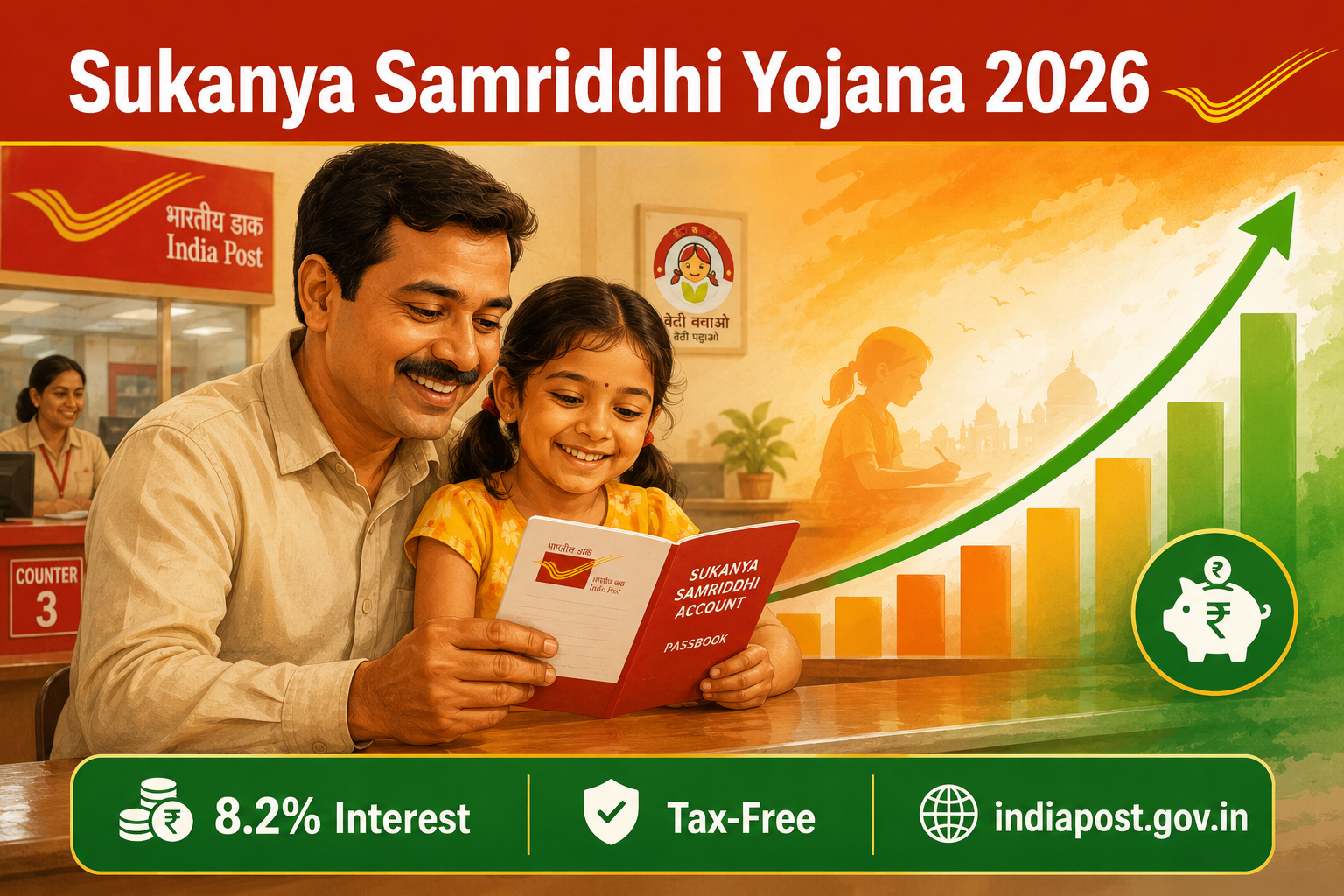
The current interest rate — applicable for Q1 FY2026-27 (April–June 2026) — is 8.2% per annum, compounded annually. This is the highest rate among all Section 80C small savings instruments in India right now, including PPF which sits at 7.1%.
Below are honest maturity estimates at different annual deposit levels, based on 8.2% compounded annually over 15 years of deposits, then continuing to earn interest through the 21-year maturity. [VERIFY BEFORE PUBLISH — confirm exact figures using the official SSY calculator at indiapost.gov.in; interest rates are revised quarterly and actual returns will vary if rates change.]
| Annual Deposit | Total Deposited (15 yrs) | Approx. Maturity Amount | Approx. Gain |
|---|---|---|---|
| ₹250 (minimum) | ₹3,750 | ~₹11,000 | ~₹7,250 |
| ₹5,000 | ₹75,000 | ~₹2.1 lakh | ~₹1.35 lakh |
| ₹50,000 | ₹7.5 lakh | ~₹21.5 lakh | ~₹14 lakh |
| ₹1,50,000 (maximum) | ₹22.5 lakh | ~₹64 lakh | ~₹41.5 lakh |
Three layers of tax relief make these numbers better than they look. Deposits up to ₹1.5 lakh per year qualify for deduction under Section 80C. Interest earned each year is fully exempt from income tax. The maturity amount arrives entirely tax-free. This EEE structure — Exempt at entry, Exempt on interest, Exempt at maturity — means a parent in the 30% tax bracket is effectively earning a post-tax return well above the stated 8.2%.
SSY vs PPF vs Fixed Deposit — Honest Comparison
Parents consistently ask whether SSY is better than PPF or a bank FD. The answer depends entirely on your situation. Here is what each actually offers:
| Feature | SSY (2026) | PPF (2026) | Bank FD |
|---|---|---|---|
| Interest Rate | 8.2% p.a. | 7.1% p.a. | 6.5–7.5% (varies by bank) |
| Tax on Interest | Fully exempt | Fully exempt | Fully taxable as income |
| Maturity Amount Tax | Fully exempt | Fully exempt | Fully taxable |
| Section 80C Benefit | Yes (up to ₹1.5L/yr) | Yes (up to ₹1.5L/yr) | Only 5-yr tax-saver FDs |
| Lock-in | 21 years (deposits: 15) | 15 years (extendable by 5) | 7 days to 10 years |
| Who Can Open | Parent/guardian of girl under 10 | Any Indian individual | Any individual |
| Premature Closure | 5 specific conditions only | Partial from year 7 (any reason); full after 15 | Anytime with interest penalty |
| Government Guarantee | Yes — sovereign | Yes — sovereign | Deposit insurance up to ₹5 lakh only |
| NRI Status Impact | Account must be closed | Cannot open new; existing accounts run to maturity | No restriction |
The 1.1 percentage point gap between SSY and PPF looks minor. Compounded over 21 years at maximum deposit, it adds roughly ₹10–12 lakh to the maturity corpus. Over a 21-year horizon, that gap is real money.
The Withdrawal Rules — Stated Honestly
This is the section most articles either skip or oversimplify. Knowing this before you open the account is more useful than discovering it when you need the money.
Partial withdrawal is permitted after your daughter turns 18. But the conditions are specific:
The maximum is 50% of the previous financial year’s closing balance — not 50% of your total deposits, not 50% of the projected maturity value. The previous year’s balance only.
The purpose must be higher education. A college or university admission letter with fee details is required at the time of withdrawal. School fees do not qualify. Coaching classes do not qualify. A gap year between school and college? No withdrawal during that period, because there is no admission proof to present.
Premature full closure is allowed only under five specific conditions under the current Ministry of Finance rules:
- Death of the girl child
- Life-threatening illness of the account holder
- Death of the parent or legal guardian
- Marriage of the girl after she turns 18
- The account holder acquires NRI or non-citizen status
Financial hardship is not on that list. It was discussed in earlier iterations of the scheme but does not appear in the current operative rules. If your business fails, if you face a medical emergency, if you simply need the money back — none of these circumstances qualify for premature closure under the current SSY framework. The money stays locked unless one of the five conditions above is met.
On the marriage provision: some articles drop the “after 18” qualifier. The girl must be 18 or older at the time of marriage for this to be a valid closure reason.
The NRI Situation — A Financial Surprise Families Do Not Anticipate
This affects more families than the scheme literature acknowledges, particularly in states with significant overseas migration.
NRIs cannot open a new SSY account. That is straightforward. The harder situation is what happens when a family emigrates after already holding an open account.
If your family’s residential status changes to NRI — through a work visa, permanent residency abroad, or foreign citizenship — your SSY account must be closed. From the date of acquiring NRI status, the account stops earning 8.2% and interest reverts to the Post Office Savings Account rate, currently around 4%. There is no option to maintain the account at SSY rates. The account cannot simply sit untouched earning its original return.
Families who migrate mid-way through the deposit period and discover this at a bank branch have faced a material and unexpected financial loss — years of 8.2% compounding replaced retroactively with 4% from the NRI status date.
If your family has any realistic possibility of relocating abroad within the next 10 to 15 years, factor this into your decision now.
Frequently Asked Questions
What happens if I miss a year’s deposit?
The account becomes a “default account” but it is not permanently damaged. To reactivate, pay ₹50 per year of non-deposit as a penalty, plus the minimum ₹250 deposit for each year missed. Reactivated accounts continue normally. Missing a year is a nuisance, not a catastrophe.
Can I open SSY accounts for two daughters?
One account per daughter, maximum two daughters per family under normal circumstances. Twins qualify for two accounts. Triplet girls — all three accounts are permitted. A fourth daughter, however, does not qualify for a fourth account.
I moved from Jaipur to Hyderabad for work. What happens to my SSY account?
Transfer it. SSY accounts move between Post Office branches, between authorised banks, or between Post Office and bank — entirely free of charge. Visit the new branch with your passbook and a transfer request. This is a straightforward process designed for exactly the mobile working population that Tier 2 and 3 city families have become.
The 8.2% rate — is it locked in for 21 years?
No. The government revises small savings rates quarterly. 8.2% is the Q1 FY2026-27 rate. It has held at 8.2% since Q4 FY2022-23 without change, but quarterly revision is possible. The maturity amount examples in this article assume the current rate holds — actual returns will differ if rates are cut or raised. Check nsiindia.gov.in each quarter for the revised rate notification.
Can both my wife and I make deposits into the account?
Yes. Either parent can deposit into the account at any time, up to the ₹1.5 lakh annual ceiling across both. The account is in your daughter’s name — both parents operate it as joint guardians. If one parent passes away, the survivor takes over as the sole operating guardian.
How to Open the Account in 2026
Walk into any Post Office branch or an authorised bank — SBI, PNB, Bank of Baroda, Canara Bank, HDFC, ICICI, Axis, Kotak, IDBI, and Indian Bank all accept SSY applications.
You need:
- Your daughter’s birth certificate (original and photocopy)
- Your Aadhaar and PAN card (original and photocopy)
- A passport-sized photograph of your daughter
- Initial deposit: minimum ₹250, up to ₹1.5 lakh for the year
Fill Form SSY-1 at the branch. The account activates the same day in most cases. You receive a passbook. Keep it — it is your primary proof of account and records every deposit and interest credit.
After the initial setup, deposits at most authorised banks can be made via net banking. Post Office accounts still require a branch visit for deposits and most operations. Set a calendar reminder in March every year — the annual deposit must be made before 31 March of the financial year.
Open SSY If… / Consider Alternatives If…
Open SSY if: Your daughter is below 10 and you are confident your family will remain resident in India for the foreseeable future. You can lock ₹5,000 to ₹1.5 lakh per year consistently for 15 years without needing it back. You pay income tax and want the full EEE benefit. The money is genuinely for her higher education or post-18 life — not an emergency reserve.
Consider alternatives if: Your daughter is already 10 — the account option has permanently closed for her. Your family has a realistic chance of emigrating within the next decade. You may need access to the money before she turns 18 for any reason — SSY will not give it to you. You are not in a meaningful tax bracket and the 80C deduction makes little difference to your net take-home. In that case, a disciplined equity mutual fund SIP over the same 21-year horizon will likely build a considerably larger corpus — without the capital guarantee, but also without the lock-in rigidity.
SSY is not a scheme for every parent. It is a committed, long-horizon, zero-flexibility savings instrument. Its genuine strengths — the 8.2% guaranteed government-backed return, the EEE tax structure, the sovereign safety — are meaningful and real. So are its constraints. The parents who benefit most are the ones who go in knowing both sides.
Interest rates are revised quarterly by the Ministry of Finance. Verify the current rate at nsiindia.gov.in and confirm scheme rules at indiapost.gov.in before opening an account.
Ayushman Bharat Card 2026: How to Apply Online, Check Eligibility & Get Free Treatment Up to ₹5 Lakh
About the Author
C. Thiruvenkatam is the founder and editor of Daily Hind News (dailyhindnews.in), covering Indian government schemes, banking and savings instruments, civic documents, and public welfare programmes for readers across India and abroad. He has tracked Sukanya Samriddhi Yojana since its launch under the Beti Bachao Beti Padhao programme in 2015 and has followed every interest rate revision and rule amendment through successive Finance Ministry quarterly notifications. For editorial queries: dailylifearticles@gmail.com.